Introduction of research team and methods of TB-Scope.
Team
Prof. Longjiang Fan
Executive Director, Institute of Bioinformatics, Zhejiang University
PI, Air Pollution and Health Research Center, Zhejiang University
Professor, Department of Medical Oncology,
the First Affiliated Hospital, Zhejiang University
Prof. Yu Chen
Professor, Centre of Clinical Laboratory
First Affiliated Hospital, Zhejiang University
Director, Key Laboratory of Clinical In Vitro Diagnostic Techniques
of Zhejiang Province, Zhejiang University
Director, Institute of Laboratory Medicine, Zhejiang University
PI, State Key Laboratory for Diagnosis and Treatment of Infectious Diseases,
National Clinical Research Center for Infectious Diseases
Associate Prof. Yifei Shen
Associate Professor, Centre of Clinical Laboratory
First Affiliated Hospital, Zhejiang University
PI, Key Laboratory of Clinical In Vitro Diagnostic Techniques
of Zhejiang Province, Zhejiang University
PI, Institute of Laboratory Medicine, Zhejiang University
Department of Bioinformatics and Computational Biology,
The University of Texas MD Anderson Cancer Center
Methods
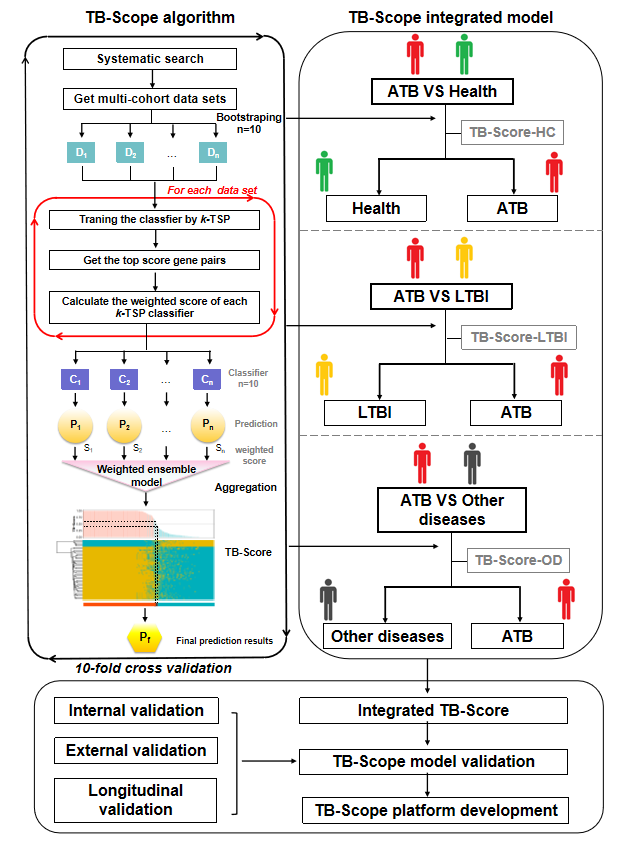
Active pulmonary tuberculosis is difficult to diagnose and treatment response is difficult to effectively monitor. The World Health Organization (WHO) and Foundation for Innovative New Diagnostics (FIND) have published target product profiles (TPPs) calling for non-sputum-based diagnostic tests for the diagnosis of active tuberculosis (ATB) disease and for predicting the progression from latent tuberculosis infection (LTBI) to ATB. A large number of host-derived blood-based gene-expression biomarkers for diagnosis of patients with ATB have been proposed to date, but none have been widely applied successfully in clinical settings. This is because batch effects and use of different data types greatly decreased the predictive performance gene expression profile-based signatures having in inter-laboratory and data type dependent validation. To address this problem and provide a more precise tuberculosis diagnosis, we developed TB-Scope, a host-gene-expression-rank based ensemble machine learning algorithm for robust tuberculosis diagnosis. Genes used in the TB-Scope could be downloaded here: TB-Scope genes.